
Vihara
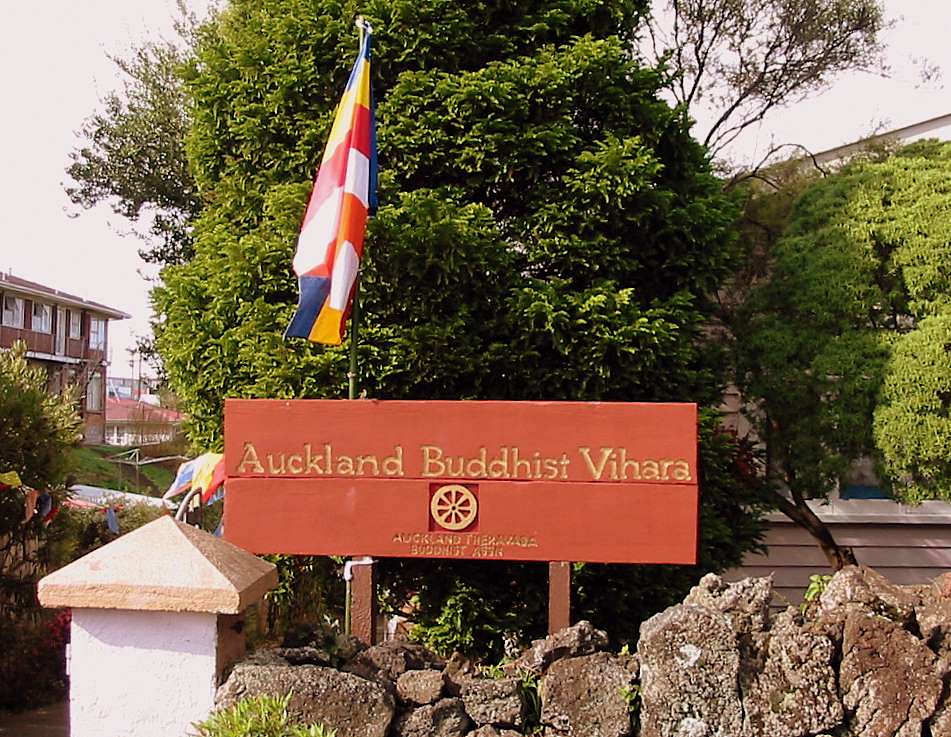
In November 1979, a New Zealand monk, Bhikkhu Uppanno (currently known as Ajahn Munindo), returned to Auckland after some years in Thailand at a forest monastery. During his stay here, he attended to the spiritual needs of Asian and Western Buddhists in Auckland, Palmerston North, Wellington and other places. He encouraged the setting up of a centre where visiting monks could stay over, permanent monks could live and the lay community grow in the Buddha Dhamma by contact with the monks and their own practices of dana, sila, puja and meditation.
To this end, the Auckland Theravada Buddhist Association (ATBA) was established in 1980. Two years later, in 1982, urged on further by Phra Khantipalo who was visiting from Wat Buddha Dhama, Sydney, ATBA acquired the present property at 29 Harris Road, which became New Zealand’s first working Theravada Buddhist temple. Situated on a section approximately a quarter acre in size, it was built about 60 years prior, on the rocks of the nearby volcano, Mt Wellington.
Presently, the property has two buildings, the original weatherboard house which has undergone major renovation, and secondly, the Shrine Room and meeting hall. The main building provides living space for bhikkhus and an attendant, community space for lay people, essential facilities and children’s classrooms. The Sunday School has been active at the Vihara since the start, being an important objective of the constitution. A variety of individuals took on responsibilities to run it, the longest serving being Benita Ameratunga.
The Shrine Room, converted from what was originally a garage and workshop, is lined and carpeted, with an altar alcove at one end. It seats over 50 people. The community meets here for regular weekly puja, meditation and dhamma talks. The Buddha image presiding over the shrine room was made and donated by renowned Sri Lankan sculptor, the Ven M Vipulasara Thera. Arrangements for its making were handled by Dr N Amarasinghe, who was able to personally take delivery of it in Sri Lanka. It was officially handed over during Sister Khema’s visit, and a special puja was conducted for its installation and to mark the end of its long journey.
The grounds have many native plants and fruit trees, including feijoas, a kiwi-fruit vine, a persimmon and a fruiting cherry. The native plantings were started at the direction of Phra Khantipalo, who also laid out a garden plan to fit our Buddhist ideals. To this day, the Bodhi tree is one of the biggest attractions to the Vihara, the tree of enlightenment to which many visitors pay homage. It was a sapling donated to the ATBA by a Frank Blom, who brought the seeds from the Anuradhapura bodhi tree and nurtured the growth to about 4 feet. It was then blessed and planted by Ajahn Sumedho and Ajahn Viradhammo. In 2024, a major Bodhi Garden Redevelopment project was undertaken to provide wheelchair access to the Bodhi tree and improve the aesthetics of the garden.
We hope the Vihara will long be the permanent base for the Theravada Dhamma in New Zealand.